Back when I was going to university, I had a chance to take an elective class. One of those classes was about the films of Alfred Hitchcock. I found it to be interesting. Not only for the history on the type of person Hitchcock was but I was finally able to watch some movies I hadn’t seen before and others that I had seen bits and pieces of, in their entirety. I know I mentioned it before in my Disturbia blog. (If you haven’t read it… Check it out.)

It was one of the most interesting electives I can remember signing up for. What I remember most is my professor, Dr. David King, going over the life of Hitchcock. I am not sure I was ever familiar with the fact that he only passed away 7 years before I was born. I, for some reason, really believed that he had lived LONG ago especially since he was born in 1899. I think I had gotten used to seeing him and his movies in Black and White and thought these were done longer ago than they were.
Background FAQs
Hitchcock is regarded as one of the most influential figures in the history of cinema with a career spanning six decades. He directed over 50 feature films, many of which are still widely watched and studied today (obviously..) Hitchcock became known as the Master of Suspense and easily recognized because of his many interviews, his cameo appearances in most of his films, (I see where Stan Lee got it from.) and his hosting and producing the television anthology Alfred Hitchcock Presents (1955–65). He received the BAFTA Fellowship in 1971, the AFI Life Achievement Award in 1979, and was knighted in December of that year, four months before his death in April of 1980.
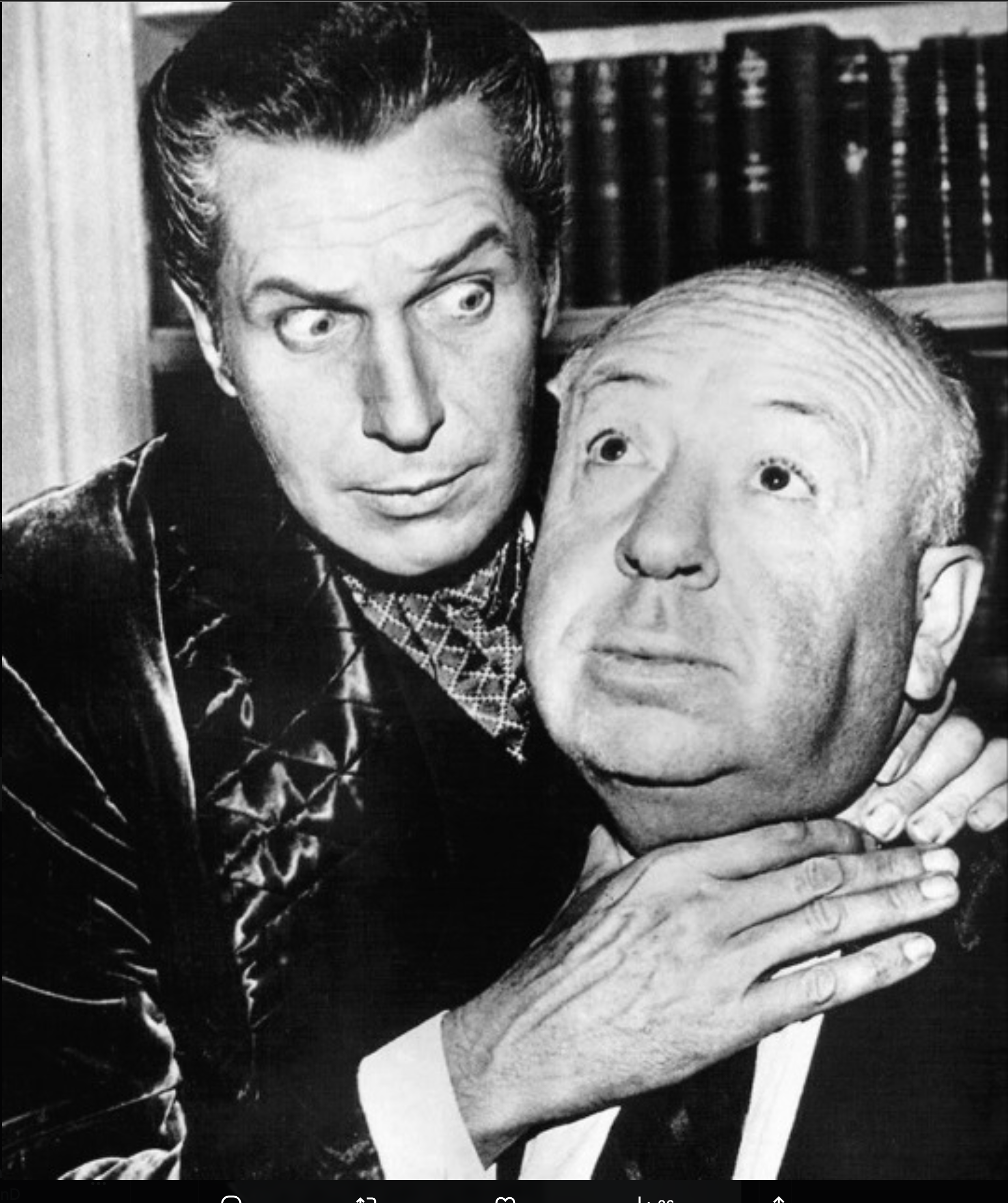
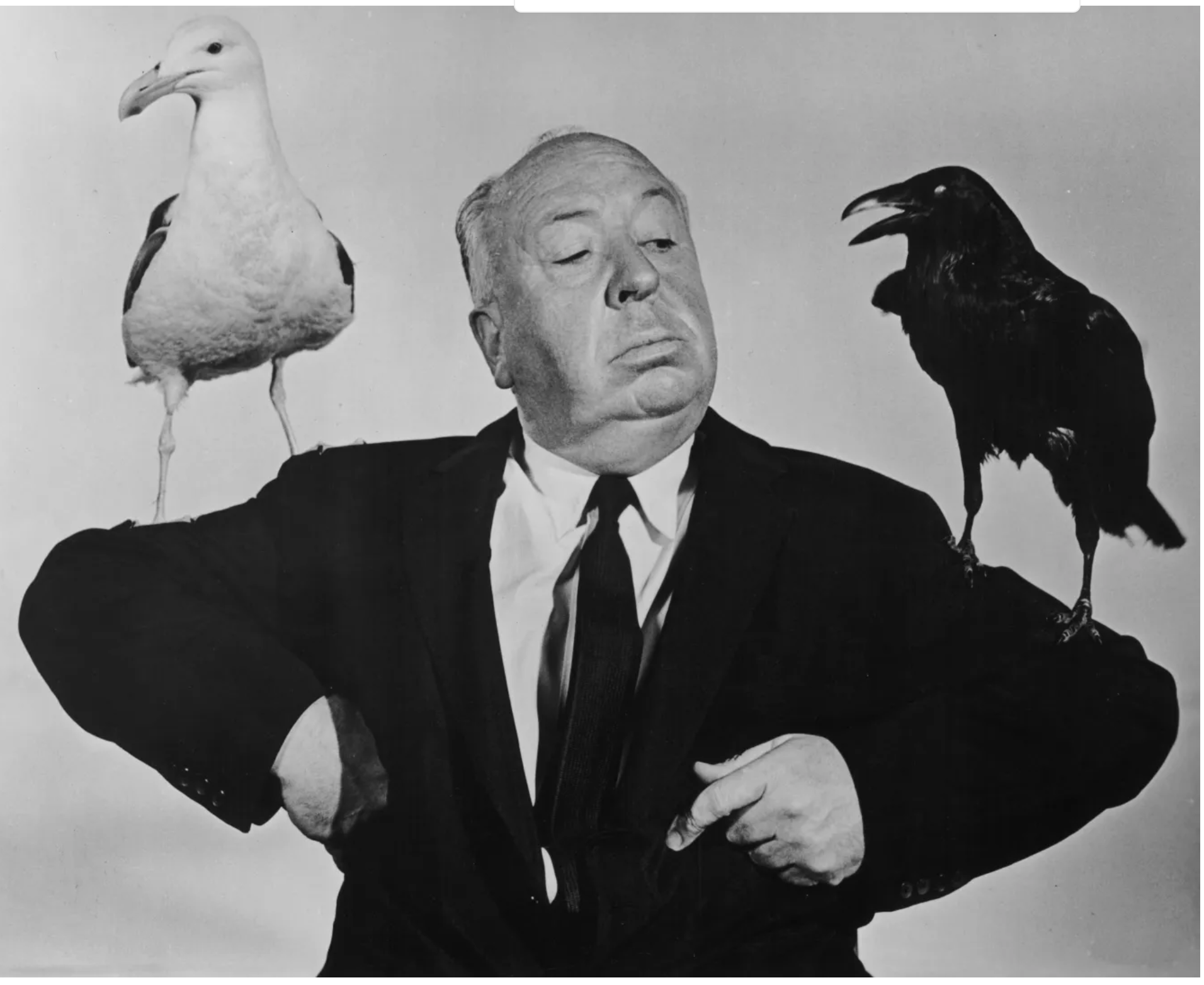
His films garnered 46 Academy Award nominations, including six wins, although he never won the award for Best Director, despite five nominations. I would love to dig into who was winning on him consistently. I wonder if it has to do with a lot of his films not doing as well when they first were put out.
Hitchcock made a number of films with some of the biggest stars in Hollywood at the time, including four with Cary Grant, four with James Stewart, three with Ingrid Bergman and three consecutively with Grace Kelly.
My Top AH Movies
I’m going to revisit the Hitchcock films from that class that stayed with me; the ones that creeped me out, the ones that gave me a sense of how these things could actually happen and the ones made me appreciate just how sharp, strange, and brilliant Hitchcock could be.
And because you know I love a good list, let’s jump right in. As always… Spoilers ahead….
Rear Window: I think that I have said… this was my favorite movie of his. And my college campus was the first place I had ever seen it. Rear Window is a mystery psychological thriller film that came out in 1954. The film stars James Stewart, Grace Kelly, and Raymond Burr. Rear Window is considered by many filmgoers, critics, and scholars to be one of Hitchcock’s best films. (I know I do…) It received four Academy Award nominations, and was ranked number 42 on AFI’s 100 Years…100 Movies list. I believe this has to do with the simple nature of the story as well as all of the ethical questions that are presented in the film.
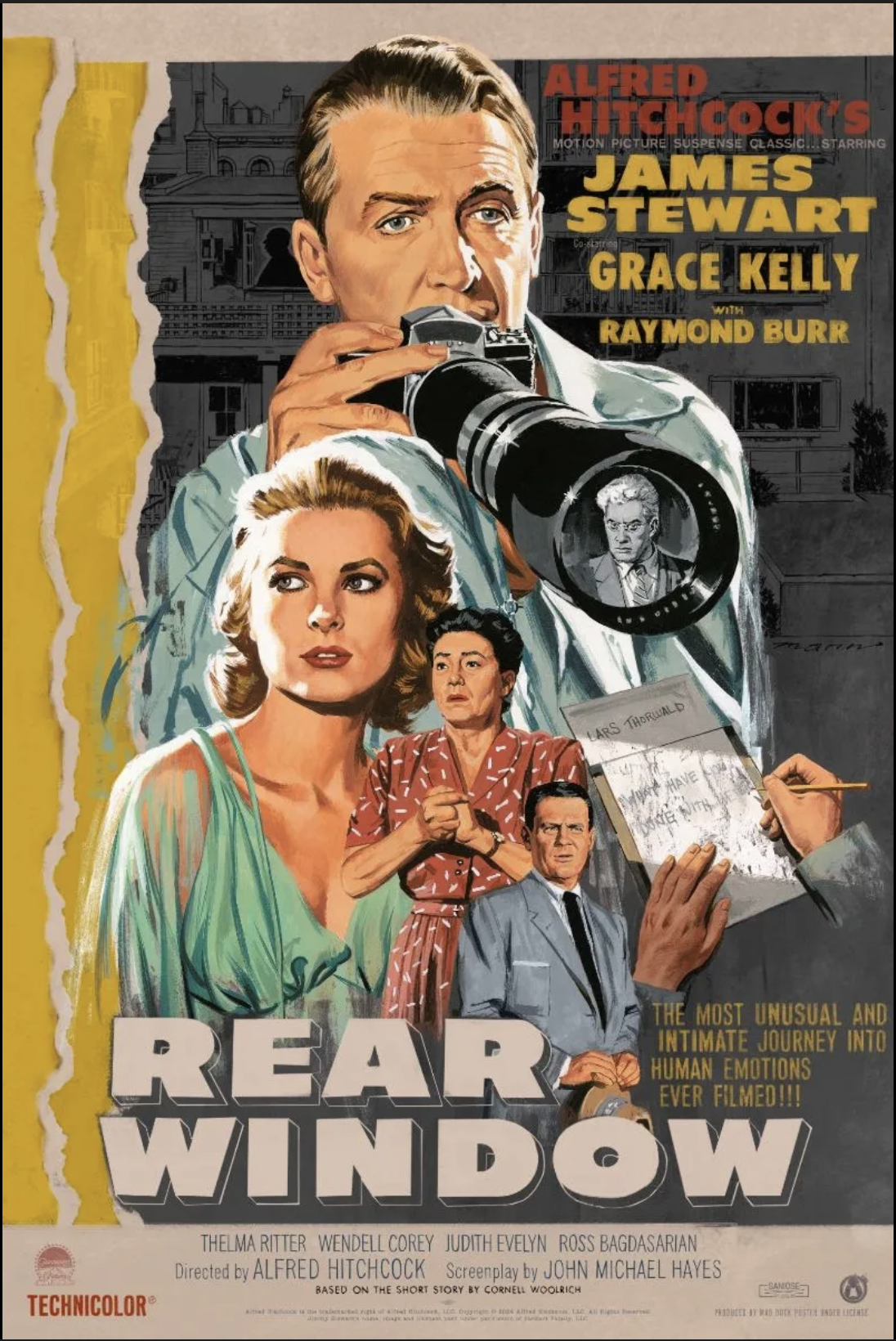
Professional photojournalist L.B. “Jeff” Jefferies, has broken his leg and is sitting in his Greenwich Village apartment .His leg is in a cast from his waist to his foot, and he is confined to a wheelchair. (The wheelchair strikes me a plot device…Disturbia uses the ankle monitor instead.)The rear window of the apartment looks out onto a courtyard with small garden plots, surrounded on four sides by other adjoining apartment buildings. During this time where Jeff is sidelined, he really only visited by his nurse and his girlfriend, Lisa Fremont.
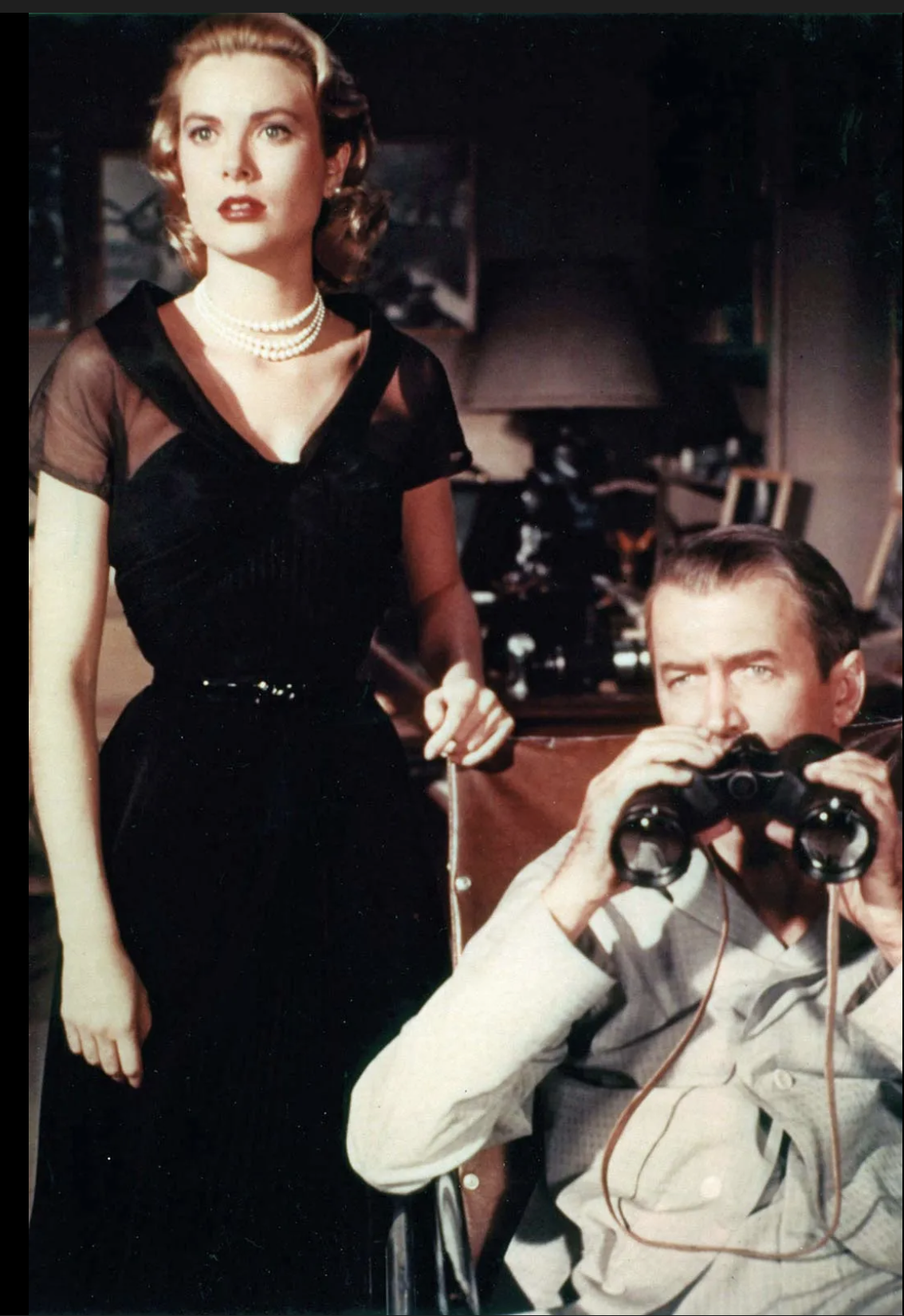
During a heat wave, with boredom setting in and nothing else to do, Jeff decides to watch his neighbors in the other buildings. It starts out as an innocent at first. Jeff gives names to all those he starts out watching: a professional dancer coined “Miss Torso”; a songwriter with writer’s block; a spinster who pantomimes dates with pretend suitors, “Miss Lonely-Hearts”. He focuses on the traveling costume jewelry salesman Lars, who is has a bedridden wife. One night, Jeff hears a woman scream, followed by the sound of breaking glass. Later that night, Jeff wakes as a thunderstorm breaks; he observes Thorwald making repeated trips out of the apartment carrying his sample case. (What could he be doing? Does he have a good reason? Maybe? Most likely not?)
The next morning, Jeff notices that the Thorwalds’ shades are drawn, (Red Flag) Thorwald’s wife seems to be gone, and Jeff sees Thorwald cleaning a large knife and a handsaw. Movers haul away a large trunk. After surveilling with binoculars and a camera with a telephoto lens, Jeff grows suspicious of Thorwald’s activities. ( But he has also kind of descended in to an obsession with spying on the neighbors and catching Lars at something.)

Convinced that Thorwald has murdered his wife, he first tells Stella, who becomes morbidly interested in the case, and then Lisa, who doubts him until they notice that Thorwald’s wife is no longer in bed and the mattress is rolled up. Of course, most people think that Jeff has lost his mind and needs to find something else to do to pass the time. What is interesting to me is how Lisa… starts out skeptical… and then becomes deeply enthralled in trying to find out if Lars is a killer and then capturing said killer. So much so she breaks into Lar’s apartment to look around and see if she can find clues. I do not know about you… but if I thought someone was a murderer… No one could talk me into going into where I think someone was killed.
Lisa is searching the place when Lars returns unexpectedly and catches her in the act. Even though she attempts to talk her way out of trouble Lars is unconvinced. He attacks her, causing Lisa to cry out. Jeff and Stella call the police. The operator finally connects Jeff with the police, and he reports that a man is assaulting a woman at Lars’s apartment. The police arrive to intervene as Lisa and Lars scuffle. The anxiety that I felt watching her through Jeff’s eyes, as helpless as he is, hoping we don’t have another dead body on our hands was off the charts. During police questioning, Lisa signals to Jeff that she is wearing Mrs. Thorwald’s wedding ring. Rather than expose Thorwald, Lisa allows herself to be arrested for breaking and entering so she can get to safety. I couldn’t shake the feeling that this misstep brought danger right to their doorstep. I wasn’t wrong.
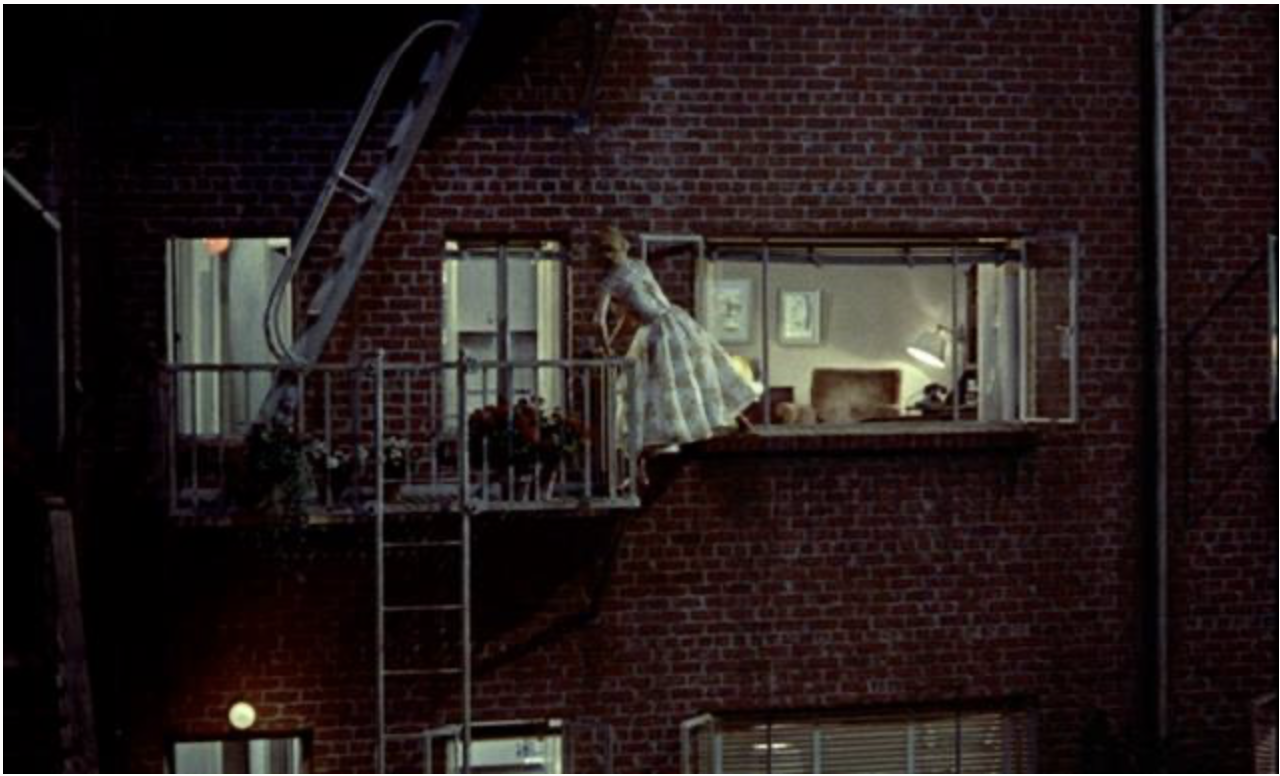
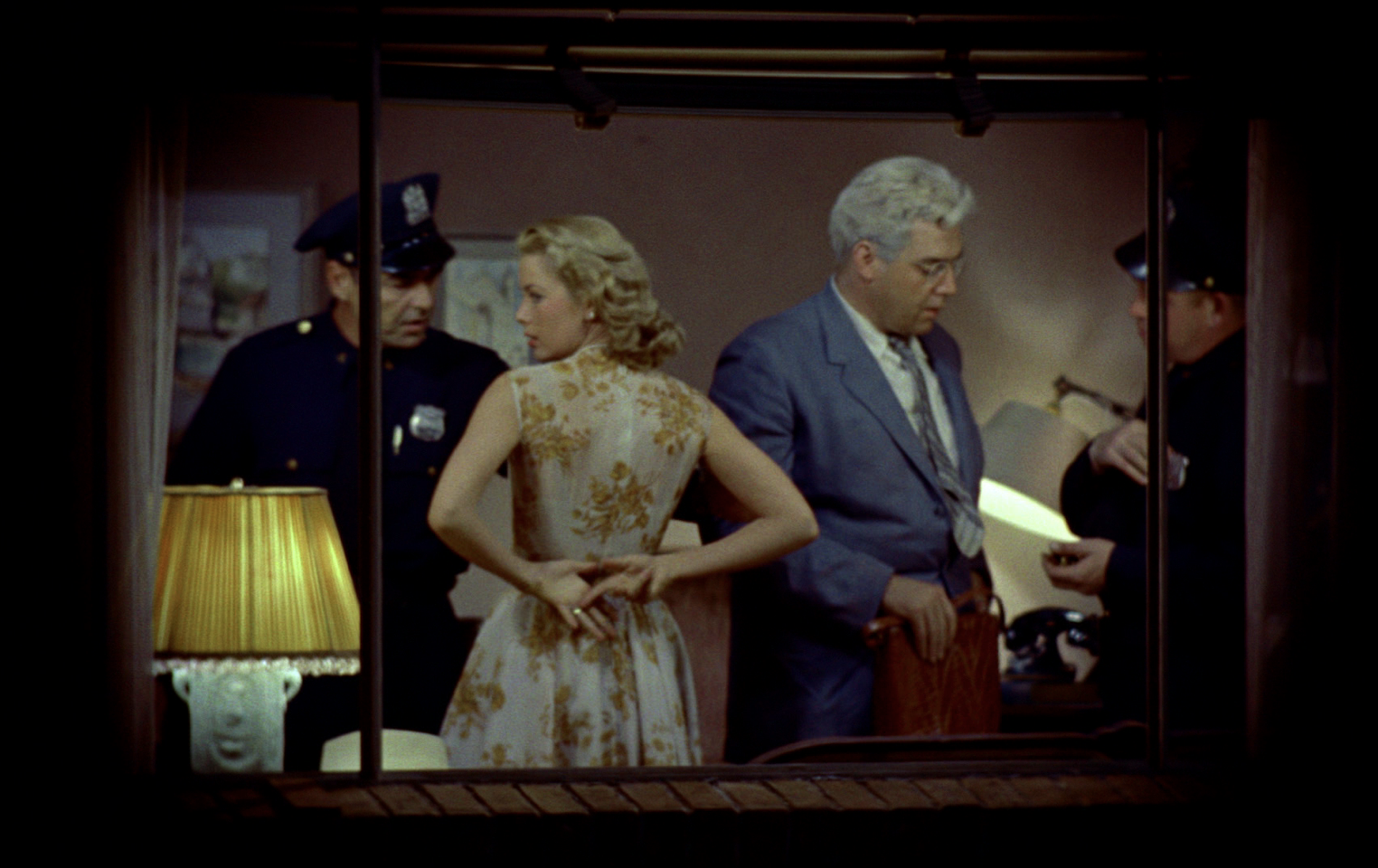
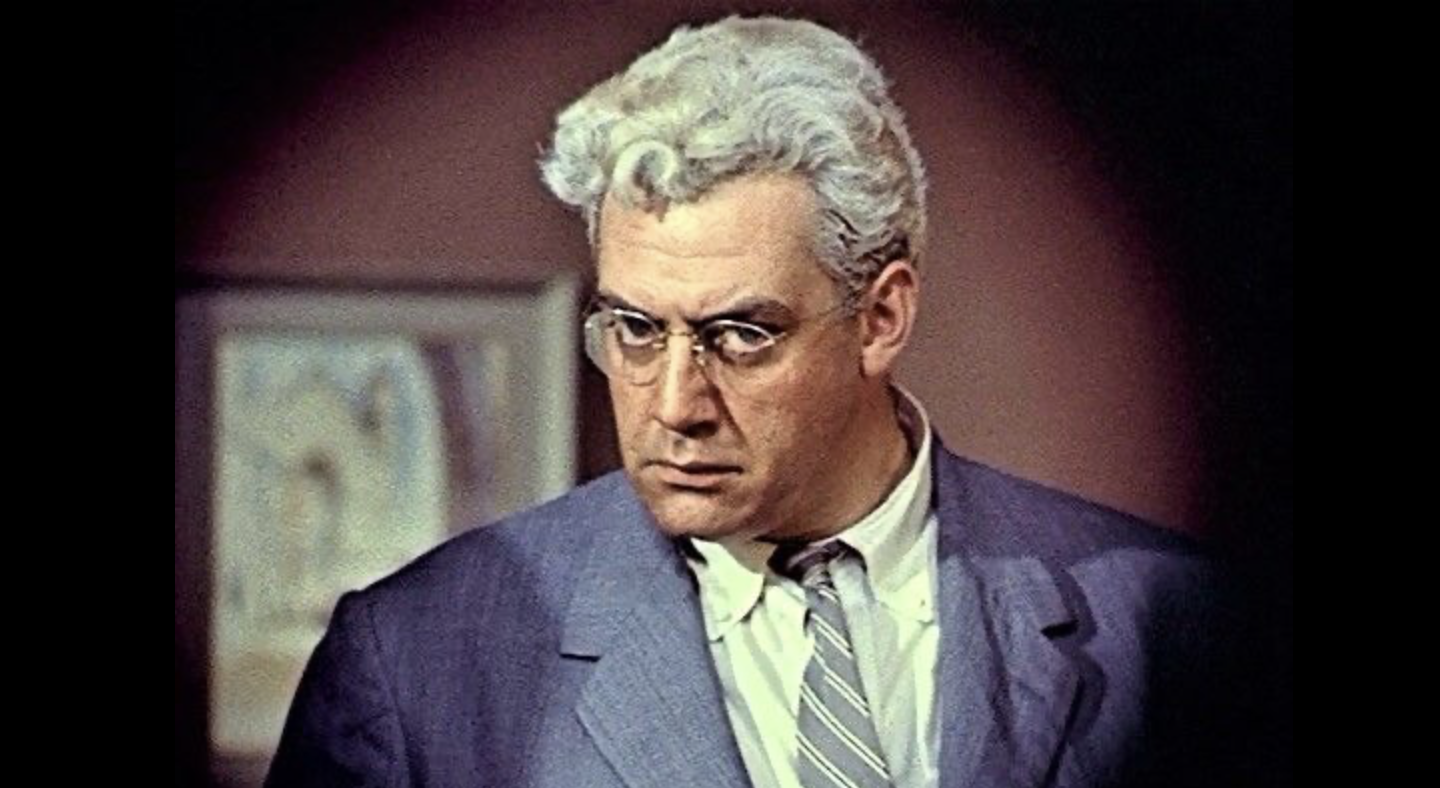
Thorwald realizes Jeff is surveilling his apartment. Locating Jeff’s apartment, Thorwald attacks him; Police apprehend Thorwald just as he drops Jeff out of his window. Thorwald confesses his wife’s murder to the police.
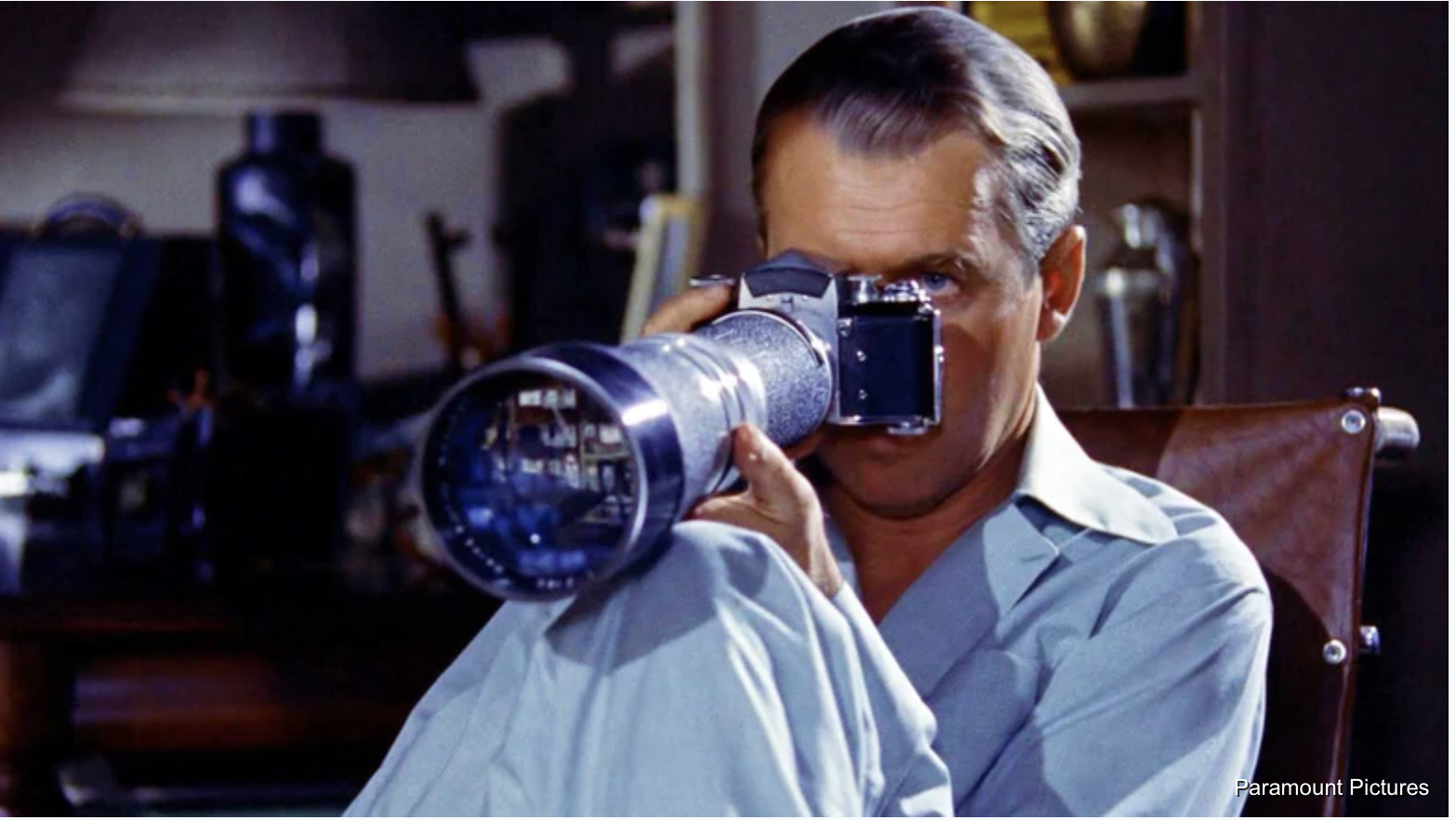
We discussed the conundrum that film posits it’s a commentary on how easily watching can turn into judging, and how judging can turn into interference. The film leaves you with a lingering question: Is it worse to watch when you shouldn’t, or to look away when someone might need help? Is what you are seeing sinister or is there a trivial explanation and who gets to judge what is odd behavior and what isn’t during people’s privacy?
We also had a class discussion on privacy in public spaces. Can that be demanded… ? For example, the neighbors have their windows open, their blinds up, and their lives on display but does that make it okay to observe them? The film suggests that visibility doesn’t equal permission. Blew my mind that this was an issue even in 1950 and in 2025 we are still dealing with this now that everyone has a camera in their pocket. The ending suggests that Jeff’s voyeurism is justified because it exposes a killer — but it leaves us with a question: does solving a crime excuse violating someone’s privacy? Many in class 13 years ago said yes. I mean obviously this man murdered his wife. But it is not something he is sure about and doesn’t really have evidence to support his claim. If it is true, then it opens the door for us to make wild unsubstantiated claims about people.
And lastly, the thing that sticks with me about this film, that has also been adopted by modern tv shows such as Dexter and You, Hitchcock made viewer the complicity in the voyeurism. You get the same view that Jeff gets out of his window, and you get to cast judgement on the people that he is seeing.The ethical question becomes: Are we any different from him? I see that we really aren’t.
Psycho 1960: I think even before this class everyone knew a bit about this movie. I had never seen it before this class even though it is his best known and most popular work. I mean everyone knows about the shower scene even if you haven’t seen it… The shower scene has become a pop culture phenomenon and is often regarded as one of the most iconic moments in cinematic history, as well as the most suspenseful scene ever filmed. The scene has been frequently parodied and referenced in popular culture, complete with the screeching violin sound effects.
But the background was even more intriguing. For example, I did not know that Hitchcock did not want people showing up to the theater late because he felt they would not get the twist at the end. Today’s audiences would rebel. Moviegoers had to be at the theater on time or they would have to come back for the next showing. Hitchcock believed people who entered the theater late and never saw the appearance of star actress Janet Leigh or what lead to her death would feel cheated. At first theater owners opposed the idea, thinking they would lose business. However, after the first day, the owners enjoyed long lines of people waiting to see the film. I wonder if people still ended up missing things if they had to go to the bathroom but I digress.
In 1992, the Library of Congress deemed the film “culturally, historically, or aesthetically significant” and selected it for preservation in the United States National Film Registry.
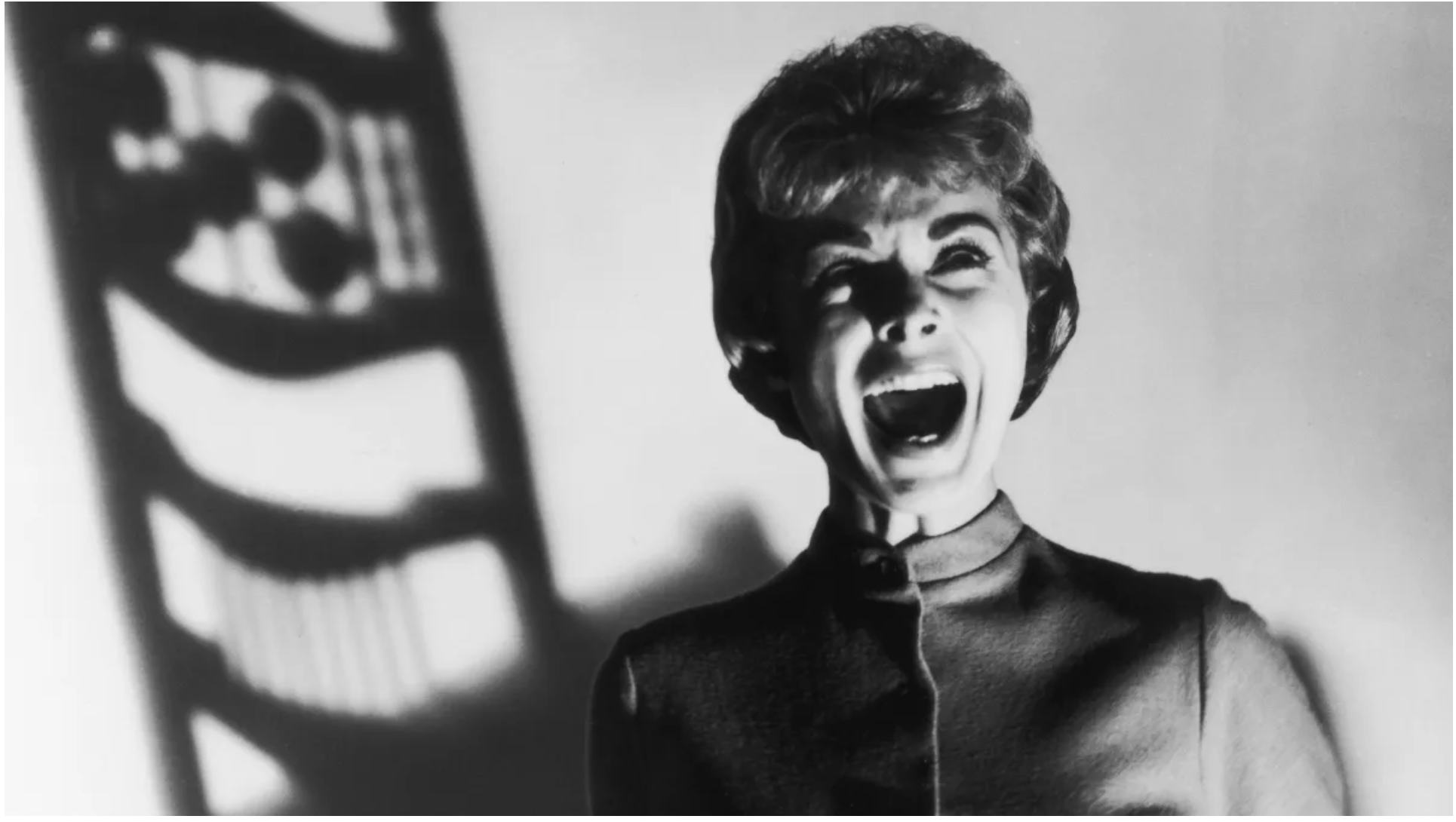
Psycho is a horror film produced and directed by Alfred Hitchcock. The film stars Anthony Perkins, Janet Leigh, Vera Miles, John Gavin and Martin Balsam. What I found to be interesting was the decision to shoot the film in Black and White when… by this time… It could have been done in color. I mean Rear Window, which had come out six years before was done in color.
Marion Crane, a real estate secretary in Phoenix, steals $40,000 in cash from her employer after hearing her boyfriend, Sam Loomis, complain that his debts are delaying their marriage. She heads to Sam’s home in California. A heavy rainstorm forces Marion to stop at the secluded Bates Motel just a few miles from Sam’s town. (Now do not even get me started on how she turned to a life of crime, stealing from her employer, because her boyfriend is a loser. It is clear that this is the decision that ultimately leads to her death later. )
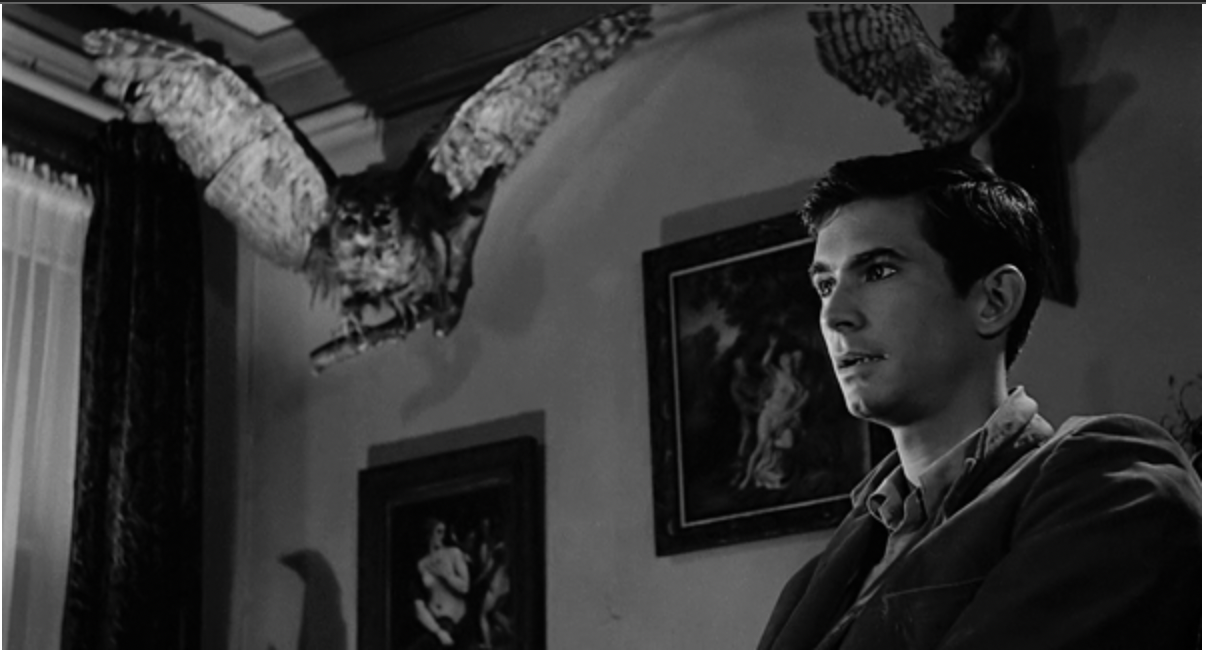
The owner, Norman Bates, registers Marion (who uses an alias) and invites her to dinner with him in the motel’s office. Norman seems as though he may be a bit awkward. But again… I am not sure that with no one else around that I would have gone to dinner with him… (I doubt it would have made a difference… her fate was sealed when she checked in anyway.) The house that he and his mother live in is overlooking the hotel… (Was that the norm back in the day? Seems odd to me.) When Norman returns to his house to retrieve the food, Marion overhears him arguing with his mother about his desire to dine with Marion. After he returns, he discusses his hobby as a taxidermist, (It is my understanding that this plays into the red flags about serial killers… I doubt Hitchcock put this in there by accident. )his mother’s “illness” and how people have a “private trap” they want to escape. Marion seems to be on guard but this whole conversation gives me the creeps. It was enough to run away into the rain for me… But alas. When Marion suggests that Norman should have his mother institutionalized, he becomes greatly offended and insists that she’s harmless.
Poor Marion sealed her fate with that crack about his mother…Marion decides to drive back to Phoenix in the morning to return the stolen money. (but even I knew at that point she was never going to make it back there. )As she showers, a shadowy figure enters the bathroom with a kitchen knife and stabs her to death. Shortly afterward, Norman is heard horrified at his mother’s actions and rushes back to find Marion dead. He hurriedly cleans up the murder scene and places Marion’s body, her belongings, and, unbeknownst to him, the hidden cash in her car, before sinking the vehicle in a swamp.
Marion’s sister, Lila, arrives in Fairvale a week later, tells Sam about the theft, and demands information about Marion’s whereabouts. Sam doesn’t know a thing about what Marion plan was or where she is. (So this man never asked her to do anything… She lost her life for nothing…. and that stays with me.) Marion knew that she was being chased… because Lila and Sam are approached by a private investigator who was hired by her employer to retrieve the money that she stole.
Arboghast (Private Investigator) stops in at the Bates Motel and questions Norman, whose nervous conduct, stuttering, and inconsistent answers arouse his suspicion. (What made him stop there was beyond me…) Arbogast examines the guest register and discovers from some handwriting in it that Marion spent a night in the motel. When Arbogast infers from things Norman says that Marion had spoken to his mother, Arbogast asks to speak to her, but Norman refuses to allow it. (When you watch it back… this stands out as a red flag that needed looked at… also along the same lines that did Marion in… oh well.)
Arbogast leaves and calls Lila to tell her of his suspicions and that he plans to go back to the motel, speak to Norman’s mother, and rejoin Lila in town later. When Arbogast returns and enters the Bates’ house to search for Norman’s mother, a shadowy figure at the top of the stairs ambushes him and slashes him around the head. He tumbles down the stairs as the figure stabs him repeatedly. Sadly, by now people had to see this coming…
When Sam and Lila do not hear back from Arbogast, Sam goes to the motel to look for him. Sam spots a silhouette in the house who he assumes is Norman’s mother, who is unresponsive to Sam’s calls. (another red flag… how many is that so far?) Lila and Sam alert the local sheriff, Al Chambers, who tells them Norman’s mother died in a murder–suicide by strychnine poisoning ten years before. (There is a lot to suggest that Norman was the one that killed her. However this starts to beg the question… who was Norman talking to at the house?) Chambers suggests that Arbogast lied to Sam and Lila so he could pursue Marion and the money. (Why would he lie to them of all people? He could have not told them anything and went on about his business… This didn’t make a lot of sense to me…)
Sam and Lila are so convinced that something nefarious happened to Arbogast and to Marion that they drive to the motel and check in. Sam distracts Norman in the office while Lila sneaks into the Bates’ house. Suspicious, Norman knocks Sam out. As Norman heads to the house, Lila hides in the fruit cellar, where she discovers the mummified body of Norman’s mother. (Now this is wild for the time… but I remember being both unsettled and understanding where more modern movies got there idea from.) Lila screams in horror alerting Norman who appears wearing women’s clothes and a wig, enters the cellar and attempts to attack her, only to be subdued by a recovered Sam.
At the police station, a psychiatrist explains to Lila, Sam, and Chambers that Norman killed his mother and her lover out of jealousy. Unable to bear the guilt, he stole his mother’s corpse (WILD) and treated it as if she were still alive, then re-created his mother as an alternate personality, as jealous and possessive toward Norman as he felt about his mother. It seemed to me that this was saying that she was not this jealous and possessive… but I mean… I think given some of the information we are given in the movie… there is some merit to her being just as nuts, jealous and controlling. The explanation which is pretty sophisticated in my mind, talks about how whenever Norman was attracted to a woman, “Mother” would take over. The “Mother” personality killed two women even before he killed Marion and Arbogast. The psychiatrist concludes that “Mother” has now completely submerged Norman’s personality. Only “Mother” exists now. Norman sits in a jail cell and hears his mother’s voice stating the murders were his doing and she seems aghast that someone would try to blame her. But the last shot of Norman with the skull is bone chilling. Meanwhile, Marion’s car, which contains her remains and the stolen money, is pulled from the swamp.
We had a pretty lengthy discussions about how this movie and the Norman Bates character paved the way for what seems in this day and age to be the norm of the unreliable narrator and the plot twist ending. Made me think of movies like Fight Club, Unbreakable, The Sixth Sense, Gone Girl, Identity, Frailty and Shutter Island. (But at the same time… Maybe I just have a type of story that I love.)
- These movies seem have taken the identity as the core twist of these movies which starts with Hitchcock.
- Psycho – Norman’s split identity – We now know that his mother has been dead a whole decade… we were lead to believe that he was arguing with a real person.
- Fight Club – The Narrator is Tyler Durden – The unreliable narrator.
- Unbreakable – Elijah is the villain… what we are told about him in the beginning much like what we first given about Norman is not what is cracked up to be.
- The Sixth Sense – Malcolm is dead. I go more depth into this in my blog post on this… but most of what we see is not the truth of it, Malcolm for his part is also along for the ride. I fear that M. Night Shyamalan just dug Hitchcock’s plot twists.
- Gone Girl – Amy’s victim persona is a performance. Nothing about her predicament is true… or what we are lead to believe in the beginning… and the real victim is actually her husband.
- Identity – There are two parallel stories told here… but the movie is called Identity for a reason. What we are originally told about these separate stories is subverted when you learn that all the people are the motel are Malcolms identities. Taking the idea of DID (Dissociative Identity Disorder) to a new level.
- Frailty – the narrator’s identity and moral alignment are revealed to be the opposite of what we are lead to believe – A Plot Twist of Identity indeed.
- Shutter Island – Teddy is actually Andrew Laeddis. We are all lead to believe that we are looking for a missing patient… Except Teddy is who we are looking for. Subverted Identity again.
All eight films use identity deception, unreliable perception, and psychological conflict to manipulate the audience and deliver a twist that reframes the entire story.
One of the other things that Dr. King talked about was what we thought was Norman’s upbringing based on what we saw. I remember him writing on the board that Norman is both devoted to her and imprisoned by her which leads to him killing her. Norman becomes instantly defensive when Marion suggests institutional help for his mother, reacting with disgust and fear. I said earlier that this was the first red flag… because the music instantly changes… He instantly becomes less pleasant… Even when Marion apologizes… he makes cutting remarks at her. Norman’s demeanor suddenly goes from being perfectly calm to filled with suppressed, unsettling, quiet rage in the blink of an eye. “She’s as harmless as one of those stuffed birds.” The was great foreshadowing for what came next.
When asked by Marion, if he goes out with friends… Norman’s response is to say a boy’s best friend is his mother. An odd response for a grown man. Another red flag as to what is going to come. He also goes on to tell Marion that he was born into his trap (his mother) and has grown to not mind it. The conversation shows a young man who has never developed a life outside his mother’s shadow. He has no friends, no romantic relationships, and no independent identity. Norman suffered severe emotional abuse as a child at the hands of his mother, Norma, who preached to him that sexual intercourse was sinful and that all women (except herself) were whores. It is why he is so torn between liking Marion and having to kill her.
The supposed murder suicide was that of Norma and her boyfriend at the time. There is no way that you can deny someone relationships outside of you, brainwash them into thinking that finding others attractive is a sin and then discard him to take a boyfriend of your own. That could have only ended violently. After committing the murders, Norman forged his mother’s suicide note to make it look like she had killed her boyfriend and then herself. After a brief hospitalization for shock, he developed a split personality (DID), assuming his mother’s personality to repress his awareness of her death and thus escape the guilt of murdering her. Although, even with that her influence continues even after her death shaping his psyche and actions. I remember a student next to me stating that him keeping her corpse would suggest more than grief more like full psychological collapse. I also wonder did anyone else come and look for those other two women that were killed before Marion? You wonder if he hadn’t been caught how much worse this could have played out.
The Birds 1963
Here is a movie that I had to watch in class that I had only seen a few scenes from. Oddly enough, I can safely say this is the reason I do not like birds now. OF ANY KIND.
The Birds is a natural horror film produced and directed by Alfred Hitchcock, and starring Rod Taylor, Jessica Tandy, Suzanne Pleshette, and introducing Tippi Hedren in her film debut. It was apparently loosely based on a short story of the same name by Daphne du Maurier. The movie focuses on a series of sudden and unexplained violent bird attacks on the people of Bodega Bay, California, over the course of a few days.
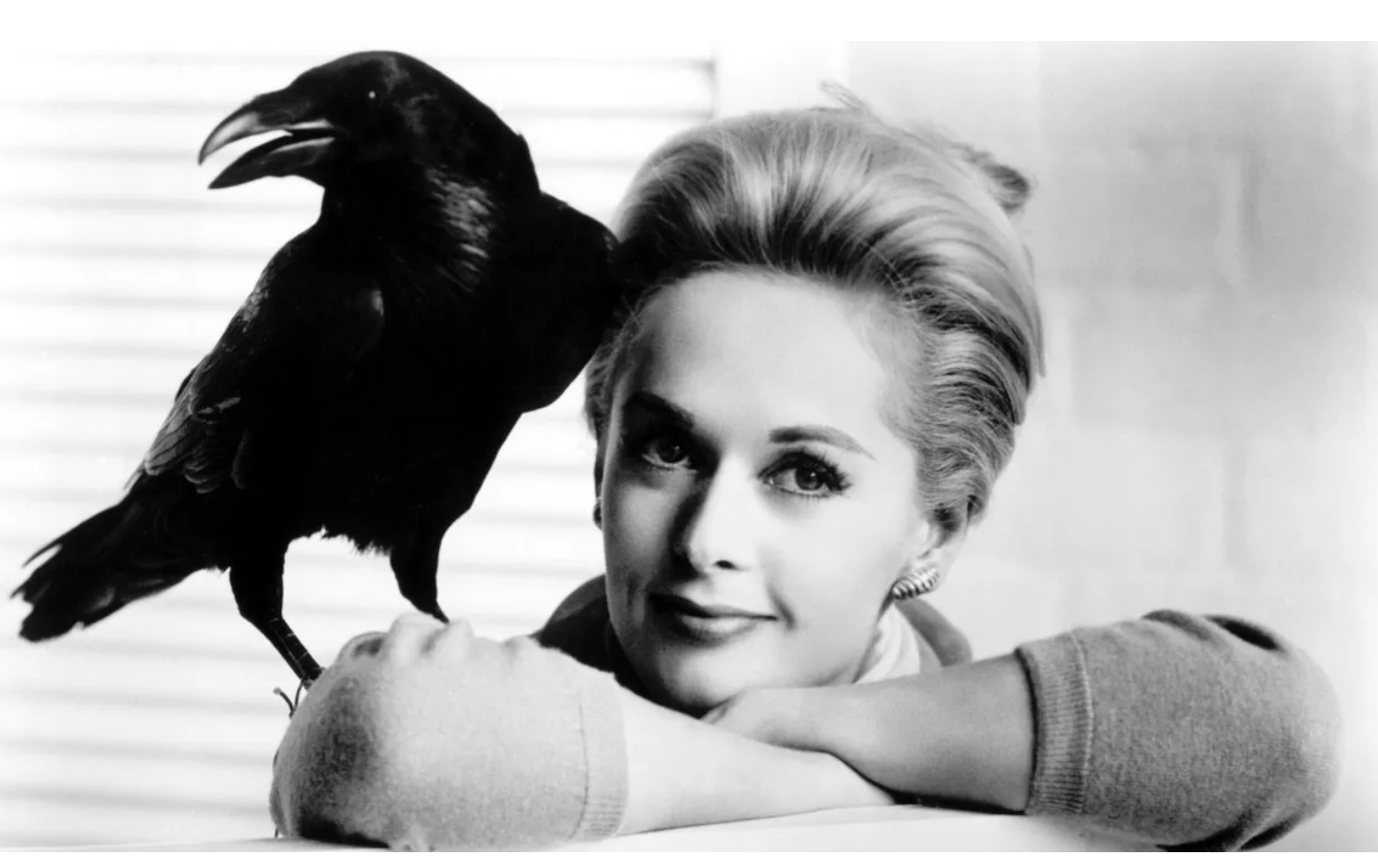
For this movie to be as old as it is, I wondered how he was able to film bird attacks the way he did. It is still so creepy to me years later. I remember being told that there were real birds attacking and I wonder what that was like for Tippi Hedren.
I didn’t realize that nature horror was a genre but I am sure it was something I wanted to much look into after this film. I also wondered why it was chosen to be shown with the others for the class but I would say I am glad that it was. Dr. King informed us that even though it initially received mixed reviews when it was released, its reputation improved over time and it has since been considered to be one of the greatest horror films of all time. A Cult Classic if you will.
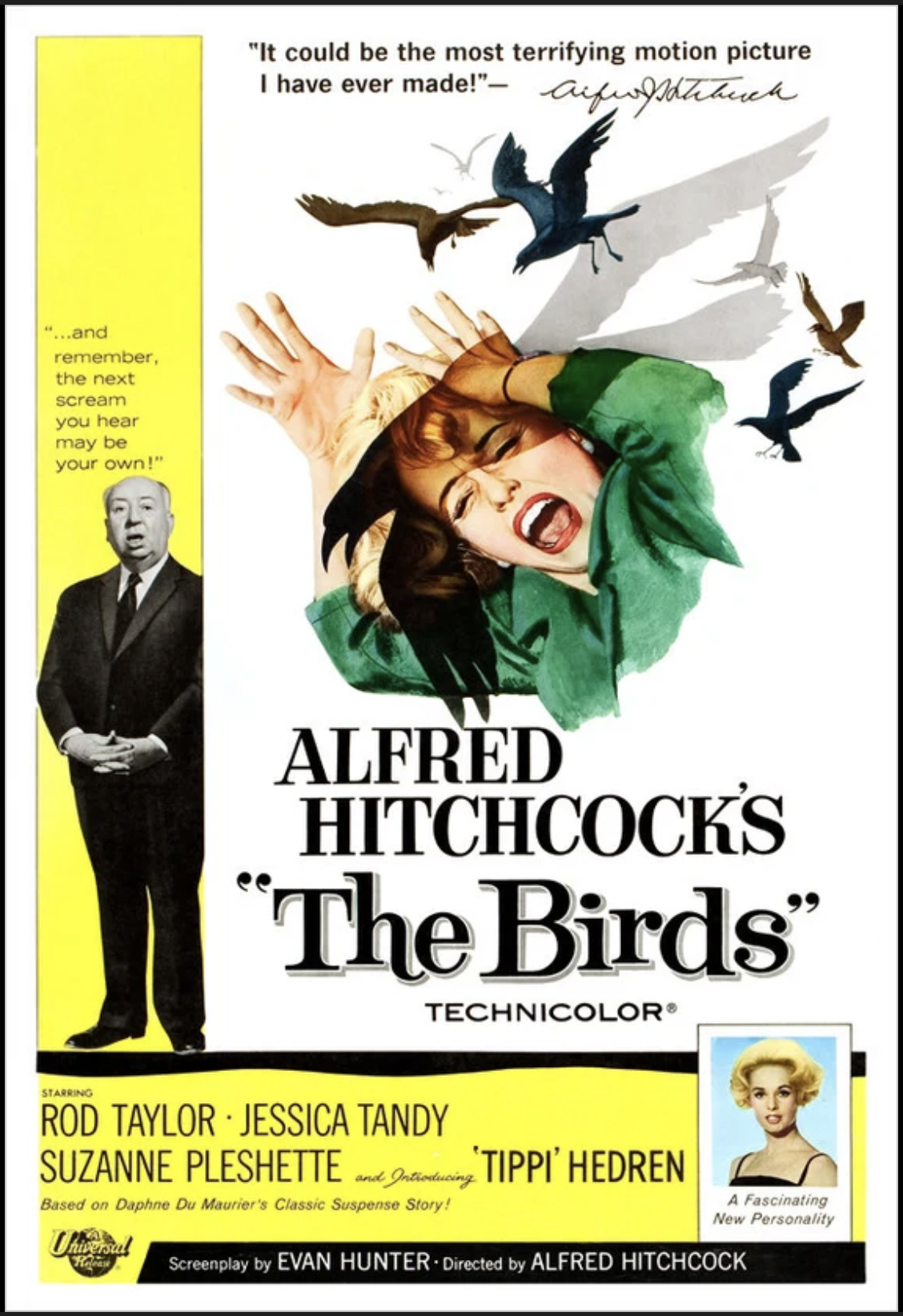
At a San Francisco pet store, socialite Melanie Daniels meets lawyer Mitch Brenner, who wants to buy lovebirds for his sister Cathy’s 11th birthday. Mitch recognizes Melanie from her court appearance regarding a practical joke gone awry and pretends to mistake her for a shop employee.
She is intrigued by Mitchell and decided on buying the lovebirds for him (well his sister) and driving up to the quiet coastal town of Bodega Bay, after learning that Mitch has gone to his family’s farm there. (This seems like a lot for a first meeting. What does she plan to do when she gets to his place? There is no way she thinks he is going to let her spend the evening with him. He clearly is going to see other people. Seems odd to me.) after learning that Mitch has gone to his family’s farm there. She learns Cathy’s name from Annie Hayworth, a teacher at Bodega. Annie is Mitch’s ex-lover, but their relationship ended due to his overbearing mother, Lydia, who dislikes any woman in Mitch’s life. (This already seems like more trouble than it is worth… Besides the last film had an overbearing mother… look how that turned out. )
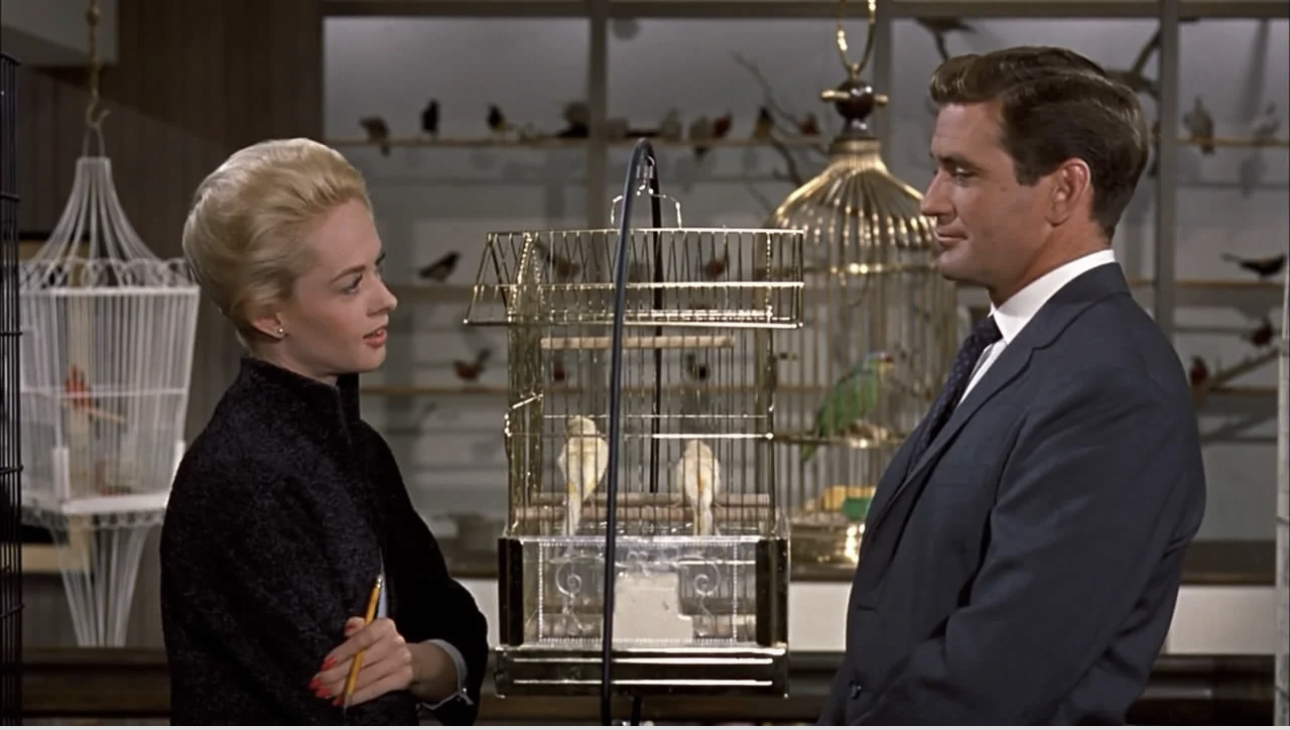
Melanie rents a boat and crosses the bay to discreetly leave the lovebirds at the Brenner farm. Spotting her departing, Mitch drives to meet her at the dock. At the wharf, Melanie is attacked by a seagull. (Now I have seen where seagulls swoop down and steal food but nothing like that…This seems like a foreshadowing event. Because not physically precipitates this.) Mitch tends to her wound and invites her to dinner.
At the farm, Lydia’s hens are refusing to eat. Lydia dislikes Melanie due to her exaggerated reputation, as reported in gossip columns. I never trust anyone who makes judgements about people they do not know and have never met based on gossip rags. Mitch invites Melanie, who is staying with Annie, to Cathy’s birthday party being held the next day. Later, a dead gull is found at Annie’s door. (Who put it there? But also… why would Annie allow Melanie to stay there? This seems too odd to me. I am sure that when I was a kid… from the bits and pieces I have seen… I am sure these adult interactions went over my head. )
During Cathy’s party, Melanie tells Mitch about her troubled past and her mother running off with another man when she was Cathy’s age. Interesting topic of conversation but I would guess nothing is off limits when it comes to dropping in unexpectedly on a person you met at the pet store. During a game, out in the backyard, the children are attacked and wounded by seagulls. What I found to be weird or eerie, was that there was never any explanation given. No one alludes to the fact that this always happens… so is this only happening because Melanie arrived? Later that evening, as Melanie dines with the Brenners, sparrows swarm the house through the chimney. (Like this seems like a coordinated attack… They came down a chimney.) Mitch insists that she delay driving back to San Francisco and stay the night. IDK… for a socialite, Melanie is going through a lot of trouble for this Mitch man. She could go back to San Francisco and not have to deal with this chaos. It is what I would have done. Mitch insists that she delay driving back to San Francisco and stay the night. And she actually listens!!!
At one point in the birthday scene, there is a little girl lying face down on the lawn and the bird going at her that is sitting on her back. The little kid in me is still unsettled. I pinpoint my fears to this scene and one other.
The next morning, Lydia visits her neighbor to discuss the problem with their chickens. (Birds everywhere acting crazy.) She discovers broken windows in his bedroom and his eyeless corpse, pecked by birds, and flees in horror. This is showing that things are escalating. The birds are going to keep attacking out of nowhere and now no one is safe. While this scene is creepy, it is not the one that stands out in my mind as a kid.

While recovering at home, Lydia fears for Cathy’s safety, and Melanie offers to pick her up at school. As Melanie waits outside the schoolhouse, a murder of crows engulf the jungle gym behind her. Anticipating an attack, she warns Annie. Rather than leaving the students in the building with its large windows, they evacuate them, and the crows attack later.
There is something in how the scene is shot. Because Melanie is sitting outside, another interesting choice given that she has been on the receiving end of an attack of birds three times now. You see the one crow behind her, and she is completely oblivious to it as she starts to smoke, more and more gather. She doesn’t notice them gathering behind her which heightens the tension. When she finally does notice… she has to make a calm collected escape. I do not even like the idea of jungle gyms after this scene.
These poor children.. one poor child broke her glasses. Their best escape plan was to outrun the birds? Oh no that seems crazy. Mitch finds Melanie at the diner. And there is this weird lady who is supposed to be an expert on birds who very loudly challenges the idea that birds are attacking people, and that multiple species of bird would be all be doing the same thing. Lady… Melanie is telling you about her own experience… SHUT UP.
When seagulls attack a gas station attendant, Mitch and other men assist him outside the diner. They spill gasoline and it is ignited by an unaware bystander’s match, causing an explosion. (This is the most chaotic scene in the movie to me. Stuff on fire… Birds everywhere. During the escalating fire, Melanie and others rush out, but more gulls attack. Melanie takes refuge in a telephone booth. Now what would make her rush out the door into the phone booth? I got nothing. The suicidal seagulls try to break into get her and Mitch has to save her. They return to the diner.
Mitch and Melanie go to Annie’s house to fetch Cathy and find Annie’s body outside; she was killed by the crows while protecting Cathy. They take a traumatized Cathy home. (Now Annie has lost her life and poor Cathy will never be the same.)
That night, Melanie and the Brenners barricade themselves in the family home, which is attacked by birds. Like they should have all been left this place. Now people they know are dead and they are at risk of succumbing to the birds as well. After discovering that the birds have pecked their way in through the roof, Melanie is trapped in the attack and severely wounded, but Mitch pulls her out. Mitch insists they all drive to San Francisco to take Melanie, now injured, traumatized and catatonic, to a hospital.
As Mitch readies Melanie’s car for their escape, a sea of birds has gathered around the Brenner house. The car radio reports bird attacks on nearby communities and that the military may intervene. Cathy retrieves her lovebirds (the only birds who do not attack) from the house and joins Mitch and Lydia as they escort Melanie past a mass of birds and into the car. Melanie starts yelling because every bird in a 200 mile radius is in their yard. She sees certain death. But they manage to make it to the car. The car slowly drives away as the birds watch.
We discussed the themes in The Birds in class. We definitely harped on Man vs Nature. This theme is the backbone of the film’s terror: the birds attack without motive, warning, or pattern. The central conflict being that humanity is confronted by a force it cannot control. Hitchcock shows this showing how quickly civilization breaks down when nature stops behaving predictably.
Humans assume they can dominate nature, until they can’t. (Jurassic Park anyone?) The attacks expose how fragile human superiority really is. There is not even a unified evacuation that can happen. One of the most unsettling aspects is that the attacks have no explanation. I realized this is what has stayed with me all these years. There was never any tangible reason for the attacks. The lack of explanation dismantles the idea that rationality can protect us from chaos.
In the end, The Birds is about humanity’s arrogance, vulnerability, and the terrifying collapse of order when nature rebels without reason.
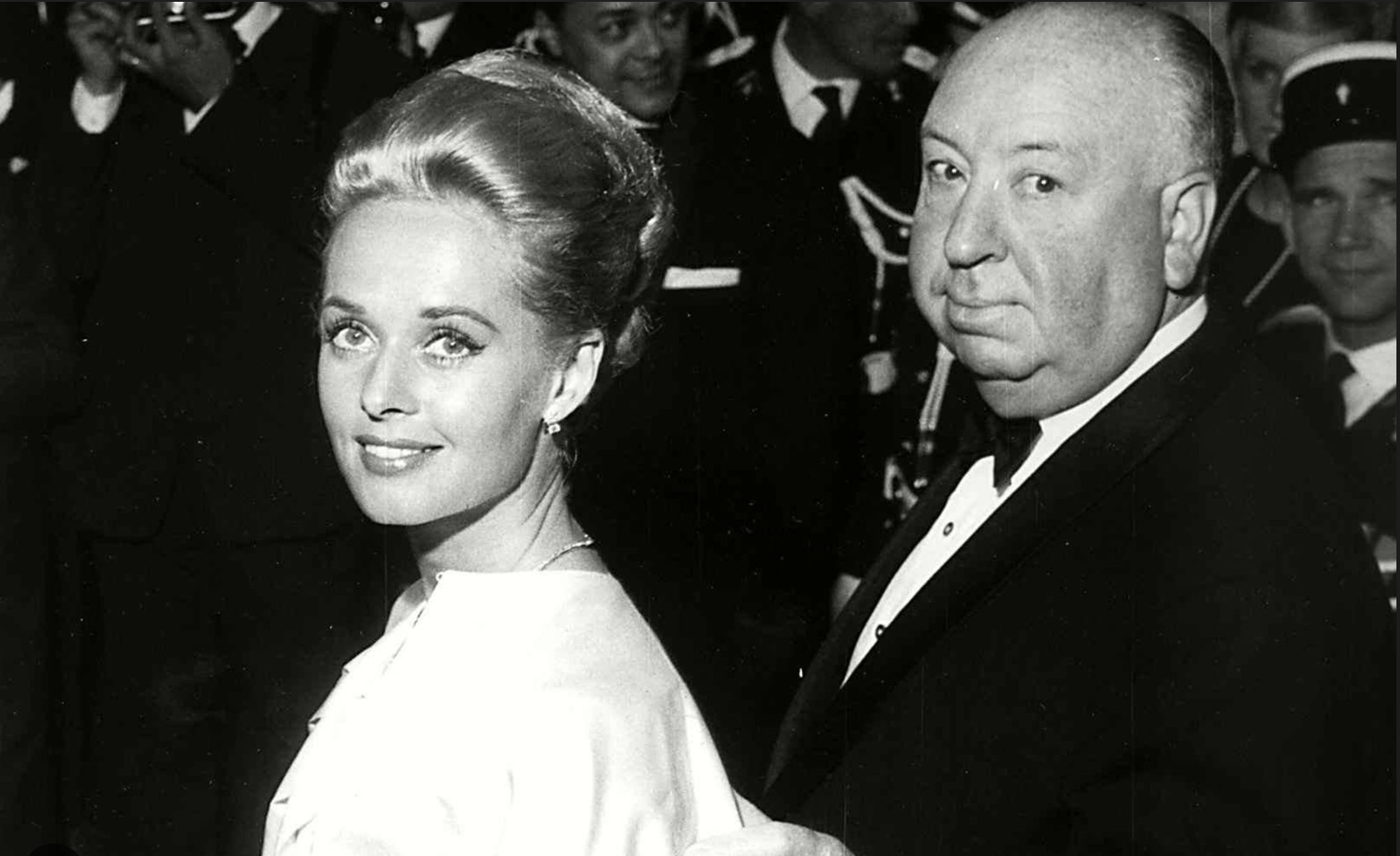
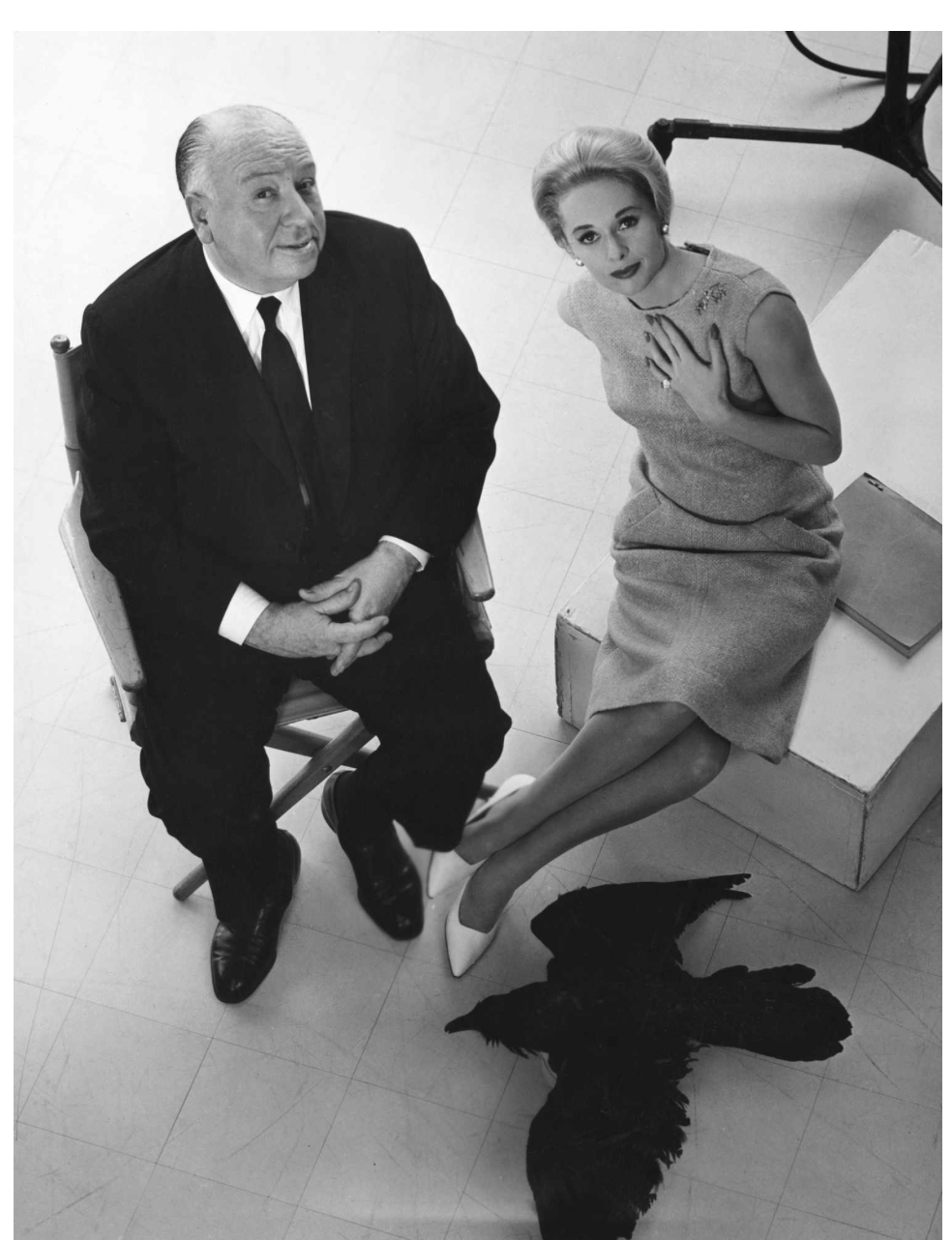
Tippi Hedren did come out and talk about his nature towards her and it would be remiss not to add them. Because we did talk at length about this in class. Tippi Hedren has talked on several occasions about her relationship with Hitchcock and claims that he stalked and sexually harassed her. Hedren has detailed these experiences extensively in interviews and in her 2016 memoir, Tippi.
Hitchcock discovered Hedren, a model, in a TV commercial in the early 1960s and signed her to a contract. Hedren claims that he was extremely possessive of her, warning her castmates, including co-star Rod Taylor, not to “touch her.” Hedren further claims that Hitchcock would stalk her, telling his driver to pass by her home, and detailed an incident in which he allegedly tried to kiss her in the back of his limo.
After Hedren insisted on getting out of her contract, Hitchcock threatened to ruin her career, telling her she couldn’t leave because of her family. He kept her under contract for two years, paying her a salary but refusing to let her take other acting roles, effectively halting her rise to A-list stardom.
“He had me followed. He would drive by my house to see whether I was home. It was becoming very, very frightening.“
Hedren did not speak publicly about the full extent of the abuse until decades later because “sexual harassment and stalking were terms that didn’t exist” at the time, and Hitchcock was an industry powerhouse. There was a lot of talk about these allegations in class following the #metoo movement.
Strangers on a Train 1951
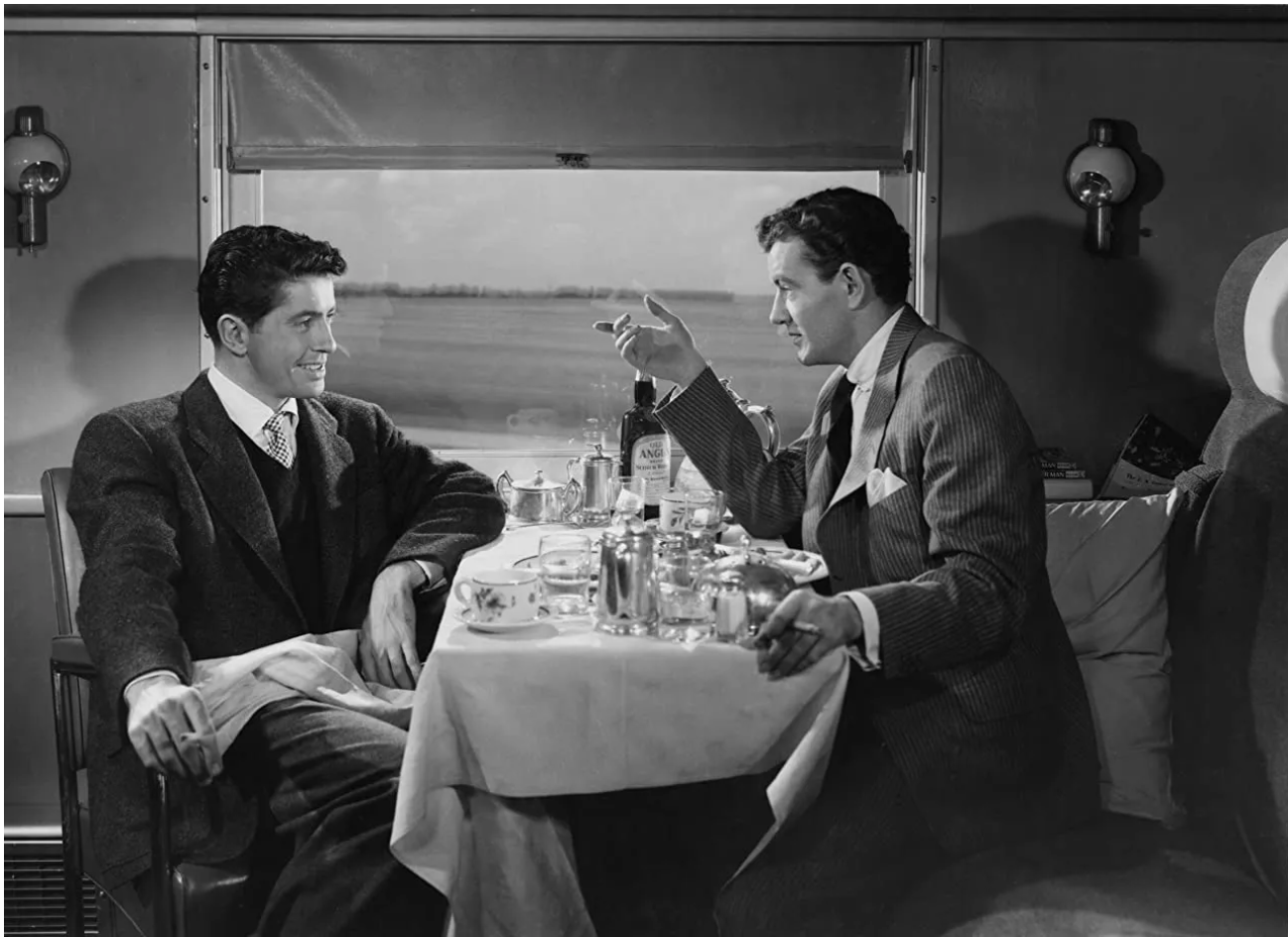
This could be why I am insistent on not talking to people on public transit. Alfred Hitchcock showed that sort of innocuous thing could end badly. Imagine you are on a train ride and the person sitting next to you is a psychopath and you have the basis of the movie. The story concerns two strangers who meet on a train, one of whom is a psychopath who suggests that they “exchange” murders so that neither will be caught.

Strangers on a Train is a psychological thriller film noir produced and directed by Alfred Hitchcock. It stars Farley Granger, Ruth Roman and Robert Walker. The film initially received mixed reviews, but has since been regarded much more favorably. In 2021, the film was selected for preservation in the United States National Film Registry by the Library of Congress as being “culturally, historically, or aesthetically significant”.
Amateur tennis star Guy Haines wants to divorce his promiscuous wife, Miriam, so he can marry Anne Morton, the daughter of a US Senator. (Was it that hard to divorce back in the day? Was there not a no-fault divorce.) On a train, wealthy smooth-talking psychopath Bruno Antony recognizes Haines and reveals his idea for a murder scheme: two strangers meet and “swap murders”, with Bruno suggesting he kill Miriam and Guy kill Bruno’s hated father. Each will murder a stranger, with no apparent motive, so neither will be suspected. Guy humors Bruno by pretending to find his idea amusing (Guy seems a little too nice for me. But he is a bit psychopathic so if he acted any other way… I am not sure it would have gone better.) but is so eager to get away from Bruno that he leaves behind his engraved cigarette lighter.
“I don’t talk much you go ahead and read.” Then proceeds to talk his ear off. And why was he so damn close… This scene is already horribly awry for me. But then Bruno goes in for the kill, by revealing that he has been reading up Guy and his romantic troubles. They didn’t have a word for this back in the day. But this seems like textbook stalking. WHERE IS HIS SECURITY???
Guy is immediately turned off at even thinking about murdering his wife. He can’t bring himself to talk about it or even think about it. But Bruno won’t be deterred. He lays out these plans of murdering someone with ease and no care of who else is on the train. He gets off at the next stop and avoids Bruno. However, he does tell Bruno that he thinks his crazy thoughts have merit. Sealing his own fate.
At one point, we see Bruno is having a conversation with his mother… and I have to say Hitchcock really has something with mothers. But the conversation is interesting in that she is worried about his mental state. She suggests that he takes vitamins to which he responds that he has. She then tells him that she hopes he has given up on the idea he had. He laughs it off as a joke. The ground work here is fantastic. She asks him to take up painting… and revealing hers shows that the family that Bruno is from is deeply disturbed.
Guy meets Miriam, who is pregnant by someone else, at her workplace in Metcalf. Guy gives her the money she demanded to pay for a divorce lawyer, but Miriam tells him she is no longer interested in a divorce, and threatens to claim that he is the father if he pursues a divorce. (You would think being a man in this situation would help him.) In a subsequent phone call to his girlfriend, Anne Morton, Guy expresses his frustration and tells her that he felt like strangling Miriam. (Like a Matlock episode) Hitchcock has shown Miriam in such an unsympathetic light so the viewer feels she really is contemptible. It really just shows misogyny at the time.
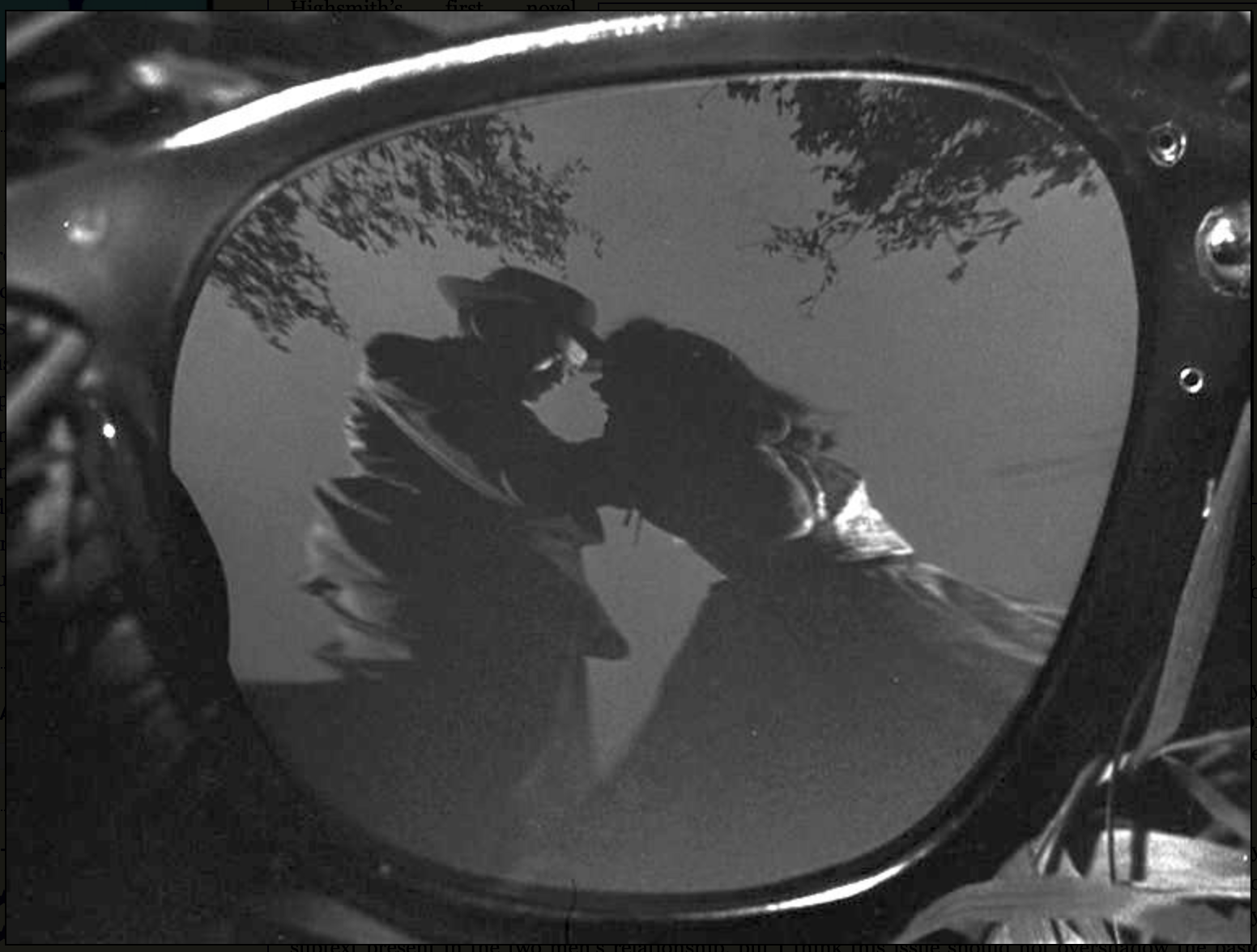
That evening Bruno follows Miriam to an amusement park (STALKER) and strangles her while Guy is on the train to Washington, D.C. When Guy arrives home Bruno informs him Miriam is dead and insists that he must now honor their deal. At no point did Guy say he was going to be involved in a deal.
What is interesting is how Bruno has it all worked out. His sing song voice is like nails on a chalkboard. He very calmly explains that him and Guy planned out the murder of his wife and that telling the police will get Guy locked up. After all Bruno has no reason to have murdered Miriam without Guy. Guy is the only one who stands to gain from it. And even though, Guy wanted no such thing… Bruno is laughing at him… we are in trouble now.
Guy goes to the Mortons’ home, where Anne’s father informs Guy that his wife has been murdered. Anne’s sister, Barbara, says that the police will think that Guy is the murderer since he has a motive. The police question Guy but cannot confirm his alibi: a professor Guy met on the train was so drunk that he cannot remember their encounter. The police assign an escort to watch him.
Barbara in this scene is a vehicle for the misogyny. It is odd that the older man has to scold her about what she saying about a dead pregnant woman. A fellow woman. SMH. Not a sorrowful bone in her body. However, no one seems to be bothered that Anne is dating a man with a wife. His wife is the only one that seems to be called names.
Bruno follows Guy around Washington, introduces himself to Anne, and appears at a party at Senator Morton’s house. (At some point, Guy is going to have to do something. Tell someone.) To amuse another guest, Bruno playfully demonstrates how to strangle a woman. Now, the way his eyes light up when talking about murder. Why is this always his talking point. His gaze falls upon Barbara, whose appearance resembles Miriam’s. This triggers a flashback: Bruno compulsively squeezes the woman’s neck, and other guests intervene to stop him from strangling her to death. (This man is showing up and strangling other people. He claims that your wife is dead and he did you a favor but it seems like you are even worse off than before.) Barbara tells Anne that Bruno was looking at her while strangling the other woman, and Anne realizes Barbara’s resemblance to Miriam. Her suspicions aroused, Anne confronts Guy, who tells her the truth about Bruno’s scheme.
Bruno sends Guy a package containing a pistol, a house key, and a map showing the location of his father’s bedroom. Guy creeps into Bruno’s father’s room to warn him of his son’s murderous intentions but instead finds Bruno there waiting for him. Guy tries to persuade Bruno to seek psychiatric help, but Bruno threatens to punish Guy for breaking their deal. (THEY HAVE NO DEAL.) For the longest time, I wondered if Bruno’s father was even alive. Like you can’t trust Hitchcock so…
Anne visits Bruno’s home and tries to explain to his befuddled and besotted mother that her son is a murderer. Bruno mentions Guy’s missing cigarette lighter to Anne and claims that Guy asked him to search the murder site for it. Guy infers that Bruno intends to plant it at the scene of the murder and incriminate him. After winning a tennis match helped by Barbara, Guy evades the police escort and heads for the amusement park to stop Bruno.
When Bruno arrives at the amusement park, a carnival worker recognizes him from the night of the murder; he informs the police, who think he has recognized Guy. After Guy arrives, he and Bruno fight on the park’s carousel. Believing that Guy is trying to escape, a police officer shoots at him but instead kills the carousel operator, causing the carousel to spin out of control. A carnival worker crawls underneath it and applies the brakes too abruptly, causing the carousel to spin off its support, trapping the mortally injured Bruno underneath. The worker who called the police tells them that Bruno, not Guy, is the one he remembers seeing the night of the murder. As Bruno dies, his fingers unclench to reveal Guy’s lighter in his hand. Realizing that Guy is not the murderer, the police ask him to come to the station to tie up loose ends.
Some time later, another stranger on a train attempts to strike up conversation with Guy in the same way as Bruno did. Guy and Anne abruptly hurry away from him.
Strangers on a Train is more than just a suspenseful thriller; it’s a meticulously crafted exploration of human nature, morality, and fate. Strangers on a Train is a psychological thriller about how a single encounter with the wrong person can unravel your entire life. The entire story begins with a chance encounter, two sets of shoes crossing paths on a train platform. Hitchcock suggests that fate is random, and a single moment can derail your life. Guy’s downfall isn’t moral failure. It is his bad luck to be the hyper fixation of a deeply ill and obsessed man. This randomness makes the story even more unsettling.
The chaos in everyday life theme is clear in the amusement park murder scene: a place of joy becomes a site of horror. Hitchcock shows how quickly order collapses when one person decides to break the rules.
I remember bringing up the idea in class that there is something deeply creepy about sitting on a train in your mundane life… and then suddenly you are thrust knee deep in a murder plot. The idea that at any point you can accused of a crime, in this case, murder that you didn’t commit. Guy’s engraved lighter, left behind on the train, becomes a symbol of this unwanted connection. There is also this idea that even in the 1950’s there was no semblance of privacy. In their first meeting, Guy doesn’t know Bruno but Bruno knows everything about him and the people around him. This is more than just reading the newspaper or gossip columns. You get the impression that this is not the first time Bruno has been in the same place as Guy. But it is the first time that Guy knows it. So unsettling.
Rope 1948
James Stewart is back on my list. The 4 films that Stewart was in were Rope (1948), Rear Window (1954), The Man Who Knew Too Much (1956), and Vertigo (1958). Rope is a 1948 American psychological crime thriller film directed by Alfred Hitchcock, based on the 1929 play of the same title. I don’t think I ever knew that many of his movies were based on books. The film was Hitchcock’s first color film. (Which shows that in 1960, it was a choice to shoot Psycho in black and white. A good one. I like it.)
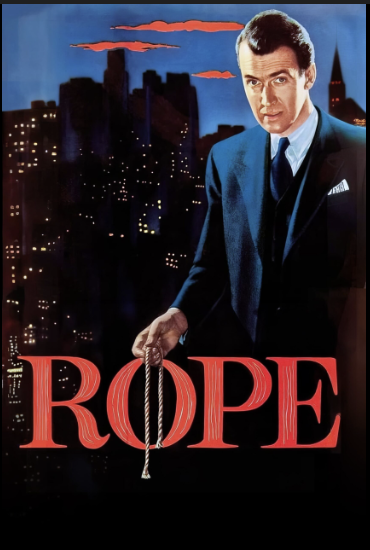
The original play was said to be inspired by the real-life murder of 14-year-old Bobby Franks in 1924 by University of Chicago students Nathan Leopold and Richard Loeb. (Folie a Deux if you will.) These two were feeding off each other and it ended tragically.

Brandon Shaw and Phillip Morgan, strangle to death their former classmate from prep school, David Kentley, in their Manhattan penthouse apartment. (My first thought was how interesting to have an opening scene where a murder is already in progress. Second thought was who is paying for this penthouse apartment?) They commit the crime as an intellectual exercise: they want to prove their superiority by committing the “perfect murder”. Brandon and Phillip stuff the corpse into a table and prepare to host a dinner party later that night.
It is Brandon who has the macabre idea of serving dinner on the trunk for their guests all of whom are friends and relatives of David. The guests, who are unaware of what has happened, include the victim’s father, Mr. Kentley, and aunt, Mrs. Atwater; his mother is unable to attend because of a cold. Also present are David’s fiancée, Janet Walker, and her former lover, Kenneth Lawrence, who was once David’s close friend.
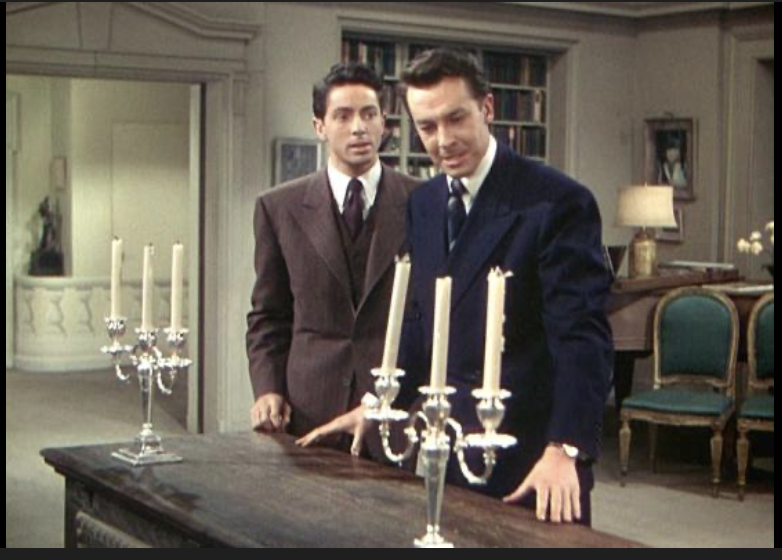
Brandon and Phillip’s idea for the murder was inspired years earlier by conversations with their prep-school teacher, publisher Rupert Cadell. Rupert had discussed with them, in an apparently approving way, the intellectual concepts of Nietzsche’s Superman, as a means of showing one’s superiority over others. He is among the guests at the party since Brandon thinks that he would approve of their “work of art.”
Brandon’s subtle hints about David’s absence indirectly lead to a discussion on the “art of murder.” (There is something in the conversation that strikes me as sinister. They are all talking about the practicality of taking someone’s life. Rupert says it can solves all kinds of problems. The line is delivered as serious but later and gives the idea as to Brandon feels Rupert would approve.) When David’s father points out that the conversation is ridiculous and in bad taste, Rupert apologizes.
Brandon is looking calm and in control, although when he first speaks to Rupert, he is nervously excited and stammering. Phillip, on the other hand, is visibly upset and morose. He does not conceal it well and starts to drink too much. Before the guests arrive though, you can start to see the different ways that they are dealing with the murder. Phillip unravels under pressure, while Brandon becomes increasingly reckless and euphoric. Rupert asks all the right questions. “Where is David?” and “Why are we eating off this thing?” that has us wondering how these two are going to be found out. The foreshadowing when Rupert points out an old story that Phillip was fascinated by in school that ends when a skeleton being found in a chest are fantastic touches.
When David’s aunt, Mrs. Atwater, who fancies herself a fortune-teller, tells Phillip that his hands will bring him great fame, she refers to his skill at the piano, but he appears to think this refers to the notoriety of being a strangler.
However, much of the conversation focuses on David, whose strange absence worries the guests. A suspicious Rupert quizzes a fidgety Phillip about this and some of the inconsistencies raised in conversation. Phillip later complains to Brandon about having had a “rotten evening,” not because of David’s murder, but because of Rupert’s questioning. Rupert is onto something that he doesn’t even realize right away.
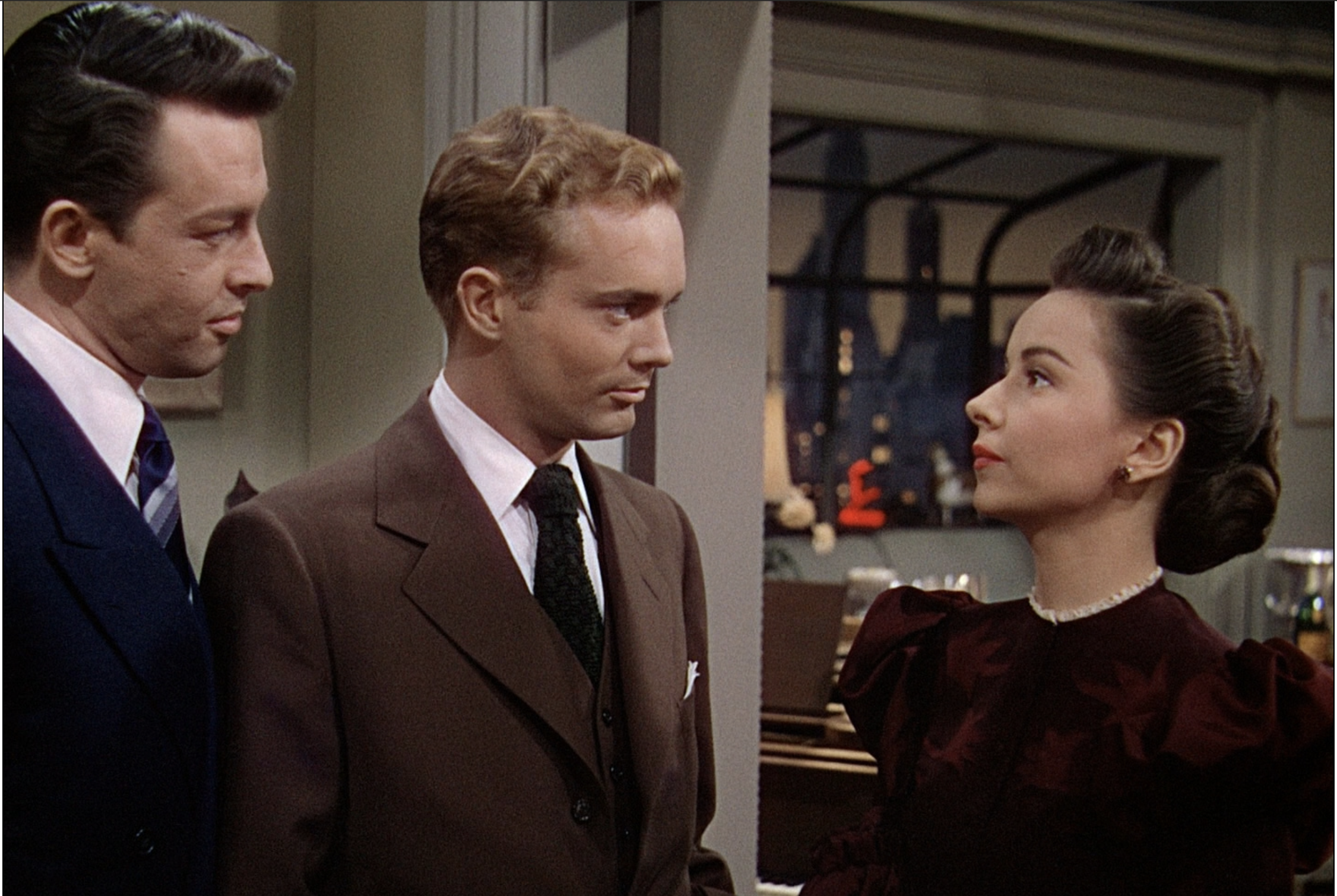
As the evening goes on, David’s father and fiancée begin to worry because he has neither arrived nor phoned. Brandon increases the tension by playing matchmaker between Janet and Kenneth. The body is almost discovered when Mrs. Wilson begins tidying up and tries to open the chest before she is intercepted by Brandon. Mrs. Kentley calls, overwrought because she has not heard from David, and Mr. Kentley decides to leave. He takes with him some first edition books Brandon has given him, tied together with the rope Brandon and Phillip used to strangle his son. (Brandon thinks this is the best thing ever. But everyone slips up somewhere.)
When Rupert leaves, Mrs. Wilson accidentally hands him David’s monogrammed hat, further arousing his suspicion. Rupert returns to the apartment a short while after everyone else has departed, pretending that he has left his cigarette case behind. He asks for a drink and then stays to theorize about David’s disappearance. So I got the idea that fddgame. He wants to tease the truth out of them. It lends to the idea that Brandon may have been right about his thoughts on their work of “art”.
He is encouraged by Brandon, who hopes Rupert will understand and even applaud their deed. A drunk Phillip, unable to bear it anymore, throws a glass and accuses Rupert of playing cat-and-mouse games with him and Brandon.

Rupert seizes Brandon’s gun from Phillip and insists on examining the chest over Brandon’s objections. He lifts the lid of the chest and finds the body inside. He is horrified and ashamed, realizing that Brandon and Phillip used his own rhetoric to rationalize murder. Rupert disavows all his previous talk of superiority and inferiority, and fires several shots out the window to attract attention. As the police arrive, Rupert sits on a chair next to the chest, Phillip begins to play the piano, and Brandon continues to drink.
Because it was a film class, we had discussions about the continuous shot illusion. The film is designed to look like a continuous shot. It’s actually composed of eight 10‑minute shots (the max length of film reels at the time) stitched together with clever “invisible” edits. My Professor thought that was the coolest thing. The edits and cuts weren’t even noticeable by me.
It was the overall themes that makes me think. For example, Intellectual Arrogance & Moral Philosophy. Both Brandon and Phillip believe they’re superior beings entitled to kill. It is easy to believe that Phillip was along for the ride but he believes in the philosophy too. He believes that he is just as elevated as Brandon. Rupert’s philosophy, which he never intended to be taken literally, becomes a weapon in their hands. It is sad. Why would Rupert be joking about murder with students? And then be shocked that they took it literally?
Performance, Theatricality or Murder for show. Both Brandon and Phillip have a party and use the chest with the dead body in it as a prop. They are performing for their guests unbeknownst to them. Dr. King told us that the suspense comes not from who did it (we know that immediately), but from watching the killers try to maintain their performance. Phillip starts to crack under pressure and that sets off the audience who have also become unwitting accomplices.
We also talked a lot about the queer subtext & repressed Identity. Homosexuality was a highly controversial theme for the 1940s. The play on which the film was based explicitly portrays Brandon and Phillip as being in a relationship though this is not expressly mentioned in the movie. We theorized as a class that this was to get around the very restrictive Hays Codes. But many of the films that are on my list here (Psycho, Strangers on a Train and now Rope) have gay coded characters. Brandon and Phillip’s relationship is coded as intimate and domestic. Their secrecy and fear of exposure parallel the experience of queer people in 1940s America.
We know today that gay men are not all effeminate, are not all mama’s boys, do not all hate women and do not all cross-dress. And they certainly are not all serial killers. And there was something about the characterization of gay people as villains with overbearing women in their lives that I didn’t like. It sparked an interesting discussion in class.
Lastly, we talked about the dangers of misinterpreted ideas. Rupert’s philosophical discussions about superiority inspire the murderers’ worldview. The film calls into question both detached intellectualism and the moral responsibility of teachers and mentors.
Conclusion
In the end, these are my top 5. With some of them, like The Birds, having a lasting effect on me. Psycho is great with Rear Window being a close second. I just know I was going to like Disturbia if they didn’t mess with it too much. The elective in college made me look at these works differently and I am glad that I did. It was an experience and told me more about myself. With my learning about my love of mysteries and twist endings. If I had to do it again, I definitely would.

 JDenise's Thoughts & Rants
Leave a comment